
Language acquisition research has long questioned the effectiveness of traditional approaches centered on grammar instruction and rote memorization. Among the alternative frameworks proposed, comprehensible input has gained particular attention for its focus on understanding as the primary driver of learning.
Rather than treating language as a system to analyze, this approach considers it a process to experience.
A Functional Definition of Comprehensible Input
Comprehensible input refers to exposure to language that learners are able to understand globally, even if some elements remain unfamiliar. The objective is not complete comprehension, but sufficient understanding to infer meaning.
This principle is closely associated with the idea that learners progress when encountering language slightly beyond their current competence. When the gap is manageable, the brain can use context to interpret new structures without explicit instruction.
Reframing the Role of Grammar and Vocabulary
In many educational settings, language is introduced through isolated components: verb tables, word lists, and rule-based exercises. While these elements can support learning, they do not necessarily lead to spontaneous comprehension.
Comprehensible input reverses this order.
Learners are first exposed to meaningful language use, allowing:
- patterns to emerge through repetition
- structures to be recognized implicitly
- vocabulary to be tied to context rather than translation
Research and applied practice both suggest that understanding messages is more effective than memorizing forms in isolation.
The Importance of Context in Acquisition
One of the key distinctions of this approach is the role of context. Words and structures are not processed individually, but as part of a larger communicative unit.
For example:
- a sentence provides cues through syntax
- visual or situational elements reinforce meaning
- repetition strengthens recognition over time
This reduces ambiguity and allows learners to build meaning without constant reference to their native language.
Managing Difficulty: The Critical Variable
A central challenge in applying comprehensible input lies in selecting appropriate material.
If the input is:
- too simple, it leads to stagnation
- too complex, it creates cognitive overload
Effective learning occurs in an intermediate zone where most of the message is accessible, but some elements require interpretation. This balance is essential for maintaining both comprehension and progression.
Practical Constraints for Independent Learners
Although the theoretical framework is well established, implementation remains a challenge outside structured environments.
Learners often face difficulties such as:
- identifying suitable content
- maintaining regular exposure
- organizing what has been encountered
In practice, this can lead to inconsistent progress, even when the method itself is sound.
The Role of Technology in Facilitating Input-Based Learning
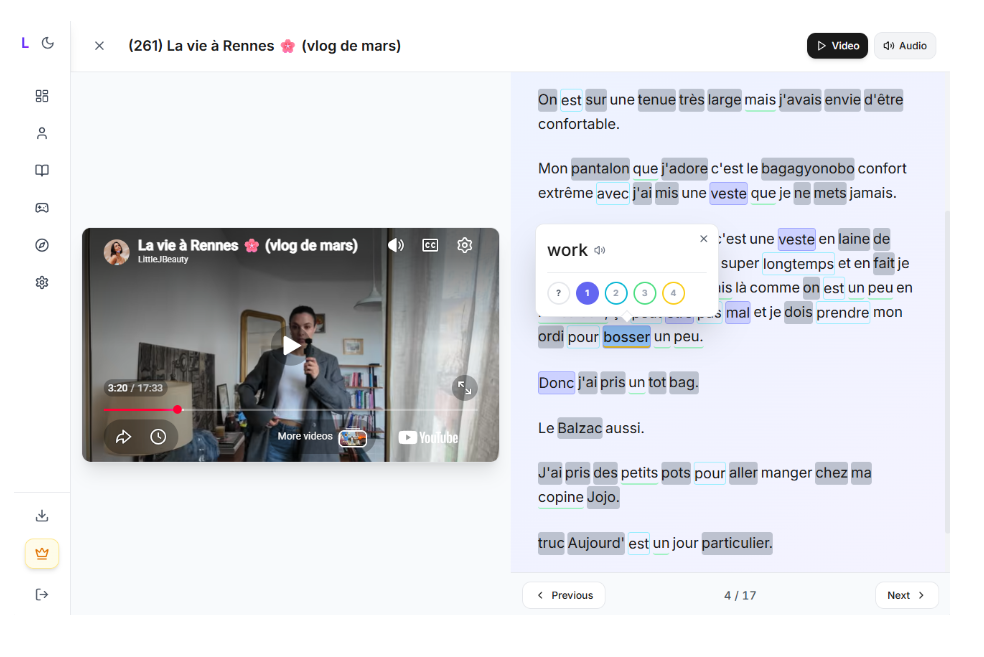
Recent developments in language learning tools aim to address these limitations by structuring access to comprehensible input.
Some platforms now integrate:
- content aligned with learner level
- contextual vocabulary support
- mechanisms for revisiting previously encountered material
In this context, solutions like Lokia illustrate how input-based learning can be operationalized. By combining real content with interactive features such as contextual lookup and spaced review, they reduce the friction traditionally associated with this method.
Integrating Comprehensible Input into a Broader Learning Model
While comprehensible input plays a central role in acquisition, it is most effective when embedded within a broader learning strategy.
Complementary elements may include:
- guided practice for production
- corrective feedback
- targeted review when necessary
This combination allows learners to move from recognition to active use without disrupting the acquisition process.
Final Perspective
Comprehensible input shifts the focus of language learning from analysis to understanding. By prioritizing exposure to meaningful language, it aligns more closely with how languages are naturally acquired.
With improved access to appropriate content and supporting technologies, this approach is becoming increasingly viable for a wide range of learners.